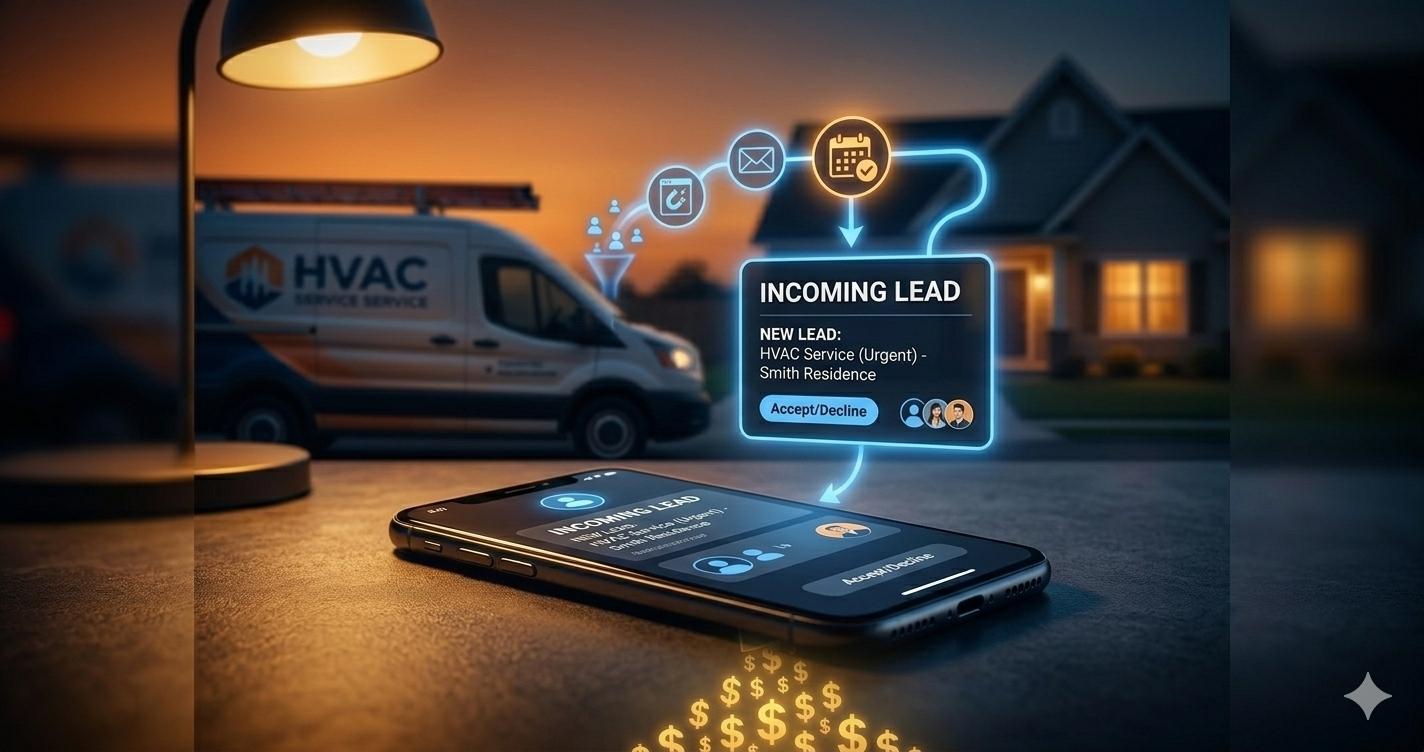
You are a good HVAC operator. Your techs are reliable. Your reviews are solid. Leads are coming in.
But the bookings are not matching the enquiries.
Here is the honest truth: the problem is not your leads. It is what happens after a lead arrives. The gap between “interested” and “booked” is where most HVAC companies lose tens of thousands of dollars a year. And almost none of them know it.
This guide explains exactly why HVAC leads go cold, what a proper follow-up system looks like, and how to build one that converts leads automatically without you chasing every enquiry by hand.
Why HVAC Leads Go Cold Before You Even Know They Arrived
Picture this. It is 7:30pm on a Tuesday. A homeowner’s AC unit stops cooling. They search Google, find your site, fill in the contact form, and wait.
By the time your admin sees that message Wednesday morning, the homeowner has already called three companies. One picked up immediately. They are already booked.
That lead was never bad. It just went cold.
This happens to HVAC businesses every single day. Not because of bad marketing. Not because of wrong pricing. Because response time in the trades is everything, and most companies are not set up to move fast enough.
A study published in the Harvard Business Review, based on 100,000 sales interactions conducted by MIT researchers and InsideSales.com, found that companies contacting leads within one hour were nearly 7 times more likely to qualify the lead compared to those who waited even an hour longer. Wait 24 hours and you are 60 times less likely to reach that person at all.
(Source: “The Short Life of Online Sales Leads,” Harvard Business Review, March 2011, Oldroyd, McElheran, and Elkington.)
For HVAC, the stakes are even higher. You are often dealing with urgent problems: a broken furnace in winter, an AC that stops working in a heatwave. The homeowner is not browsing. They need someone now. The first company that responds gets the job.
The Real Cost of Slow Follow-Up
Most HVAC owners know they miss some leads. Few have actually calculated what that costs them.
Here is a quick way to estimate it.
Say you receive 60 inbound enquiries per month. If you convert 40% of leads followed up within 5 minutes, but only 8% of leads followed up after a day, and half your leads fall into that “next day” bucket, you are losing roughly 10 to 15 jobs per month before anyone picks up the phone.
At an average HVAC job value of $800 to $1,200, that is between $8,000 and $18,000 a month in revenue that was already standing at your door.
That is not a marketing problem. That is a follow-up problem.
One of our clients said appointment bookings became more predictable within the first month after installing an automated follow-up system. Same leads. Same market. Same pricing. The only thing that changed was a system that responded before his competitor did.
Here is the thing: you do not need more leads to earn more revenue. You need to stop losing the ones already coming to you.
What Most HVAC Companies Actually Do (And Why It Fails)
The typical HVAC follow-up process looks something like this:
- A lead comes in via form, missed call, or Google Message
- Admin or owner sees it at some point during the day
- They call back manually, often hours later
- Voicemail. They move on.
- The lead never gets followed up again.
Some companies hire a VA to handle this. But VAs are inconsistent. They are not available at 8pm when leads come in after hours. They take sick days. They get overwhelmed during peak periods. The lead gets a slow response or no response at all.
The result is a revenue leak that compounds every month, silently.
This is not a staffing problem. It is a systems problem. And it has a systems solution.
The HVAC Lead Follow-Up System That Actually Works
A proper contractor lead follow-up system has four components. None of them require you to be glued to your phone.
1. Instant Response (The 2-Minute Rule)
The single biggest lever in HVAC lead conversion is speed.
Not “call back within 4 hours.” Within 2 minutes.
According to InsideSales.com research, 50% of buyers go with the first vendor that responds. In trades, where most enquiries involve an urgent problem, that advantage is even more pronounced.
The only way to respond to every lead within 2 minutes is with automation. When a lead submits a form, calls and hits voicemail, or sends a message through Google Business Profile, an automated response fires immediately. A short SMS acknowledging their enquiry. A message with your available booking slots. A link so they can self-schedule without waiting for a call back.
That first touch stops the lead from moving on to the next result in Google.
2. Missed Call Text Back
This feature is underused in the trades, and it is one of the highest-return changes you can make.
When someone calls your HVAC business and you do not pick up, what happens today? In most cases, nothing. They hang up and call your competitor.
A missed call text back sends an automated SMS within seconds of the missed call. Something like: “Hey, sorry we missed you. What can we help you with? We can fit you in this week.” That simple message recovers a meaningful portion of calls that would otherwise be lost.
A homeowner with a broken heater does not want to leave a voicemail. They want a response. An instant text message gives them one.
3. Multi-Day Follow-Up Sequences
Most leads do not book on the first contact. They go cold because nobody follows up consistently after the initial message.
A proper HVAC lead management system sends follow-up messages across multiple channels (SMS and email) over a series of days:
- Day 1: Instant response with a booking link
- Day 2: A check-in message, answering common questions
- Day 4: Social proof or a short case study
- Day 7: A direct “Still interested?” message
This is not spam. It is the kind of persistent, professional follow-up your best salesperson would do if they had unlimited time. The difference is that an automated system does it at 11pm on a Sunday without anyone touching a thing.
4. Automated Booking
Once a lead is warm, the system should offer direct booking. No phone tag. No “I will have someone call you to schedule.” A booking link in the SMS or email, connected to your calendar, with confirmation and reminder messages sent automatically before the appointment.
This reduces no-shows. It fills your schedule without admin involvement. And it happens without you or your team doing anything except showing up to the job.
What This Looks Like in Practice
A lead comes in at 9:40pm via the contact form on your website. Your admin is at home. You are watching TV.
The system fires an instant SMS: “Thanks for reaching out. We have seen your request and have availability this week. Book a time here: [link].”
The lead clicks the link and selects a 9am slot. Confirmation lands in their inbox. A reminder goes out 24 hours before.
By the time your team starts work the next morning, the job is already in the calendar. No missed lead. No manual follow-up. No chasing.
This is how service businesses stop losing jobs they were already going to win.
How to Stop Losing HVAC Leads: Your Options
You have two paths forward.
Build it yourself. Set up a CRM, configure automation workflows, build out SMS and email sequences, integrate your booking calendar, and test the whole system end to end. This takes weeks of setup and ongoing maintenance as your business changes.
Have it built for you. A done-for-you system is configured to your business and live in 14 days. You run the jobs. The system handles the follow-up, the nurture, the booking, and the reminders.
The first option works if you have a technical operator and time to spare. Most HVAC owners do not. They are running crews, managing suppliers, and quoting jobs. They do not have 40 hours to spend building CRM workflows from scratch.
If you want to see exactly what a done-for-you system would look like for your business, book a 15-minute strategy call. No pitch. Just a clear picture of what is leaking from your current process and what it would cost you to fix it.
You can also take the free lead score quiz to calculate how much revenue your current follow-up gap is costing you each month.
Frequently Asked Questions
What is an HVAC lead follow-up system?
An HVAC lead follow-up system is an automated process that contacts new leads immediately after they enquire, then follows up consistently until they book or opt out. It includes instant response via SMS or email, a missed call text back feature, a multi-day nurture sequence, and an automated booking link connected to your calendar. The goal is to convert more of the leads you are already receiving without manual effort from your team.
How fast should an HVAC company respond to new leads?
Within 5 minutes at most, ideally within 2 minutes. A study published in the Harvard Business Review, based on 100,000 sales interactions, found that companies contacting leads within one hour were nearly 7 times more likely to qualify those leads compared to companies that waited even an hour longer. For HVAC, where homeowners often have an urgent need, being the first to respond is often the difference between booking the job and losing it.
Do automated follow-up messages feel impersonal to customers?
Not when they are written well. A well-crafted automated SMS sent within seconds of a missed call or form submission reads as attentive and professional. Homeowners do not care whether the message was triggered manually or by a system. They care that someone responded quickly. The message should be conversational, relevant to their situation, and low pressure. The goal is simply to stop them from moving on to your competitor while you are busy on a job.
What is missed call text back for HVAC companies?
Missed call text back is an automated feature that sends an SMS to anyone who calls your business and does not reach a person. The message acknowledges the missed call, assures the caller that someone will follow up, and typically includes a booking link or an invitation to reply by text. For HVAC companies handling high call volumes during peak periods, it is one of the simplest changes you can make to recover leads that would otherwise be lost to a faster competitor.
How much revenue could I be losing from slow lead follow-up?
It depends on your lead volume and average job value. Take your monthly inbound enquiries and estimate how many come in after hours or during busy periods when you cannot respond within an hour. At an average HVAC job value of $800 to $1,200, even 5 recovered leads per month adds $4,000 to $6,000 in revenue. Use the free lead score quiz to get a specific estimate for your business.
The Bottom Line
You are not losing jobs because of your price. You are not losing them because of your competitors’ marketing budget.
You are losing them in the window between “lead arrives” and “someone responds.”
Close that window with a system that responds instantly, follows up consistently, and books automatically, and the revenue that was already heading your way starts landing in your calendar.
If you want to see what that looks like for your specific business, book a free 15-minute call. We will walk through your current process, show you exactly where the leak is, and give you a clear picture of what a system would recover.
Riyaz Rangrage is the founder of Zanor Digital, a done-for-you lead automation agency for local service businesses. Zanor Digital builds and manages lead response and booking systems for trades companies, real estate teams, and appointment-based businesses.
Ready to grow?
Find the right system for your service business.
Take our 3-minute quiz and we'll match you with the right package based on where your business is right now.